Hover to explore details · Select a thumbnail to change view
SILVER FOIL INNER LINING ON PAPERBOARD
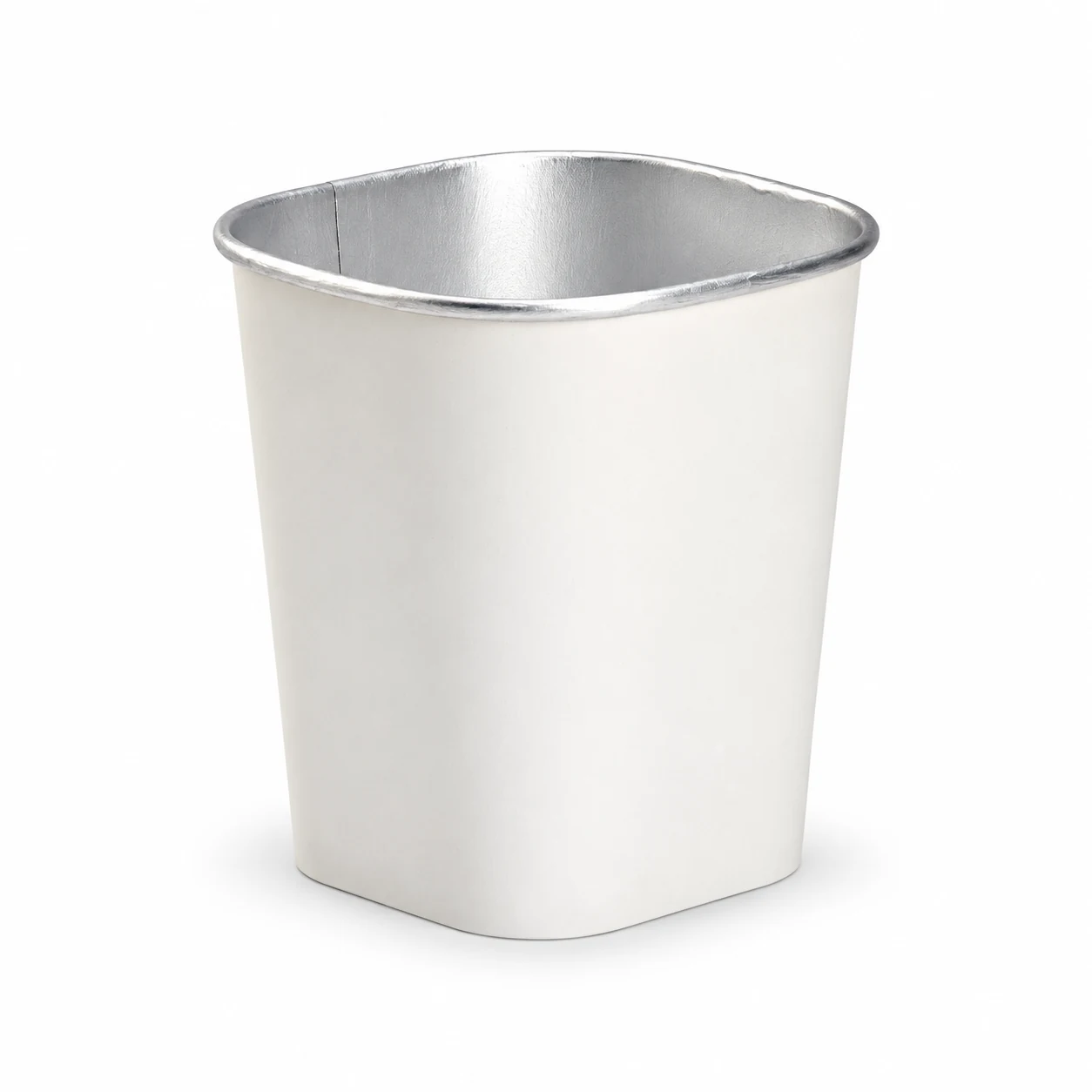
Silver Foil-Lined Square Food Cups
Explore silver foil-lined square food cups with lining guidance, reference specifications and matching-lid considerations. Custom artwork and material selection can be discussed for your order.
- Paper & lining
- Silver foil inner lining on paperboard; food-contact topcoat to confirm
- Product family
- Square Paper Food Containers
- Specifications
- Series sizes & lid options
Tell us your food, filling temperature, serving time and destination. We can discuss a suitable container, lining and lid combination.
Designed around your serving needs
Square food cups for snacks, desserts and portioned meals. The reference 680 mL format pairs with the listed 103 paper lid.
Paper & finish
Silver foil inner lining on paperboard. The pictured interior is silver foil, bonded to the paperboard structure. It offers a distinctive metallic appearance and a barrier layer; seam integrity, the complete laminate and any food-contact topcoat still need confirmation for your intended food and holding time. Do not microwave metallic-finish packaging unless the finished product is explicitly approved for that use.
Sizes & matching lids
Series reference dimensions from our product information. Photographs show example designs, not a guarantee of the pictured model, capacity or lining. Confirm the exact material–size combination in your order specification.
Reference lid: 103 paper lid, 10.3 × 10.3 × 1.6 cm. The 680 mL value is brimful capacity; leave suitable headspace for filling and transport.
Choose the right inner barrier
Paper type does not identify its lining. PE, PP, PLA and water-based barriers are options to discuss for your application, subject to the selected model, current supply and finished-product testing. They are not interchangeable specifications.
PE lining
Advantages
A well-established moisture and grease barrier with mature sealing processes. Useful when consistent liquid containment is the main selection priority.
Trade-offs
Conventional PE is not a compostable solution. Recycling depends on collection and mills that accept coated paper. Do not infer microwave suitability from the resin name.
PP lining
Advantages
A heat-resistant barrier option worth discussing for reheating applications. Suitable grades can support microwave and frozen-food packaging designs.
Trade-offs
The complete container, printing, seams and lid still need approval for the intended use. PP does not make every finished product microwave-safe or compostable.
PLA lining
Advantages
A plant-derived polymer option for projects seeking certified industrial composting pathways. It can provide a functional barrier in appropriately designed coated-paper products.
Trade-offs
Industrial compostability needs evidence for the finished item and an accepting local facility. It is not a promise of home composting, marine breakdown or high-temperature performance.
Water-based barrier
Advantages
A dispersion-applied barrier can provide liquid or grease resistance and may improve fibre recovery in a suitable, verified paperboard design.
Trade-offs
Performance varies by formulation, food and contact time. Water-based does not automatically mean plastic-free, home-compostable or universally recyclable. Confirm current supply and supporting test results.
Questions before you order
Will it leak during takeaway delivery?
Select the lining and lid together. Request a sample, fill it with your actual recipe at the intended temperature, then test holding time, tilting and delivery handling. Oil, acidity, fill level and time can change performance; a water-only check is not enough.
Can I use it in a microwave or freezer?
Use only a finished container-and-lid combination explicitly confirmed for your heating or storage conditions. Share temperature, duration and appliance method. Never treat a polymer melting point as a safe-use temperature. Metallic finishes need separate restrictions.
How do I avoid loose or incompatible lids?
Order by the confirmed rim size and model. Test closure force, seal retention and stacking with filled samples. Tell us whether you need a vented lid, drinking opening or sealed takeaway format.
What food-contact documents should I request?
Tell us your destination market, food type and conditions of use. Ask for documents and applicable migration-test results that match the exact board, lining, inks and lid. A factory audit alone is not product-specific food-contact evidence.
Is it recyclable or compostable?
Check the finished construction and the local collection route. Request the relevant evidence before using environmental claims on artwork. Paper appearance, PLA content or a water-based coating alone does not establish certification.
Will the printed colours match my design?
Provide AI or PDF vector artwork and approve the layout before production. Paper colour and CMYK printing affect the result. For critical brand colours, agree a physical reference and acceptable variation before production.
What should I send for a bulk-order enquiry?
Include capacity or model, quantities, paper finish, preferred lining, lid, artwork, food temperature and destination. Request samples and confirm the final dimensions, packing quantities, production schedule and inspection requirements in the order.
Plan your custom packaging
The source specification lists 5,000 pieces for standard paper and metallic-paper custom work, 30,000 for double-coated constructions and 50,000 for PLA-lined orders. These are reference minimums; confirm the combination, current capacity and artwork before ordering. Water-based barriers and new sizes need individual confirmation.
Start with a sample and an agreed specification, approve the artwork, then confirm production and delivery. Lead time varies by construction and order; it is confirmed with your project.
Material guidance sources
General material guidance, not certification of this product: Stora Enso barrier coatings; NatureWorks composting; FDA food types and conditions of use; BioPak packaging FAQs.